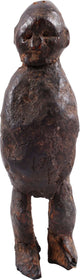
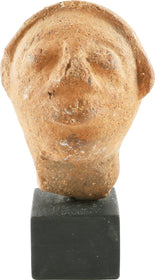
Male, 7 1/4 height with serene countenance and hands drawn to the distended abdomen. The head with large ring edged fetish cavity containing fetish material at the bottom.
|
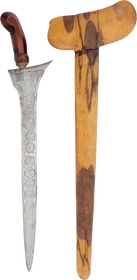
31 1/2 overall length. A silver band below the head engraved REV R. S. CHAPLIN and bearing English hallmarks and a makers mark J K.
|
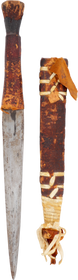
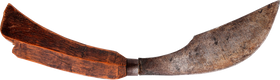
Fine fighting knife proportions as found with bowie knives in North America. 14 1/4 clipped point blade struck with the archangel mark of Needham, Veall & Tayzack, recorded in Sheffield from 1865-1925.
|
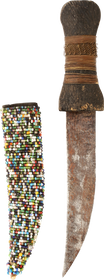
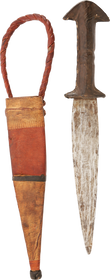
23 1/2 clipped point blade marked JOSEPH BEAL & SONS SHEFFIELD. Beal is recorded working in 1876. Two piece horn grip secured with four large rivets.
|
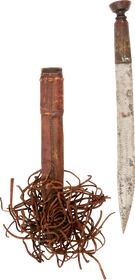
Large early example with 9 down curved pattern welded blade. One piece contoured black horn grip. Wood scabbard with large horn throat and horn tip. Shows age throughout with dark patina, surface encrustation and minor checks to the scabbard and hilt. Bl
|
7 blade. The field offset in two planes at the medial, each with the edge raised to the plain of the opposite side. Each edge of recurved profile with the distinct Tetela barb terminals. Four decorative perforations to the center.
|
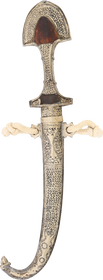
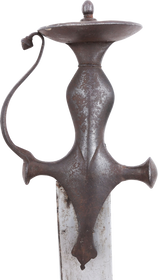
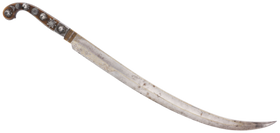
14 curved s.e. wedge section blade with scalloped back with elaborate chiseled pattern surrounding a brass inlaid roped segment, each side. Elegant scrolling iron guard with thickened quillon terminals. White metal or base silver hilt embossed in scrolli
|
Actual Markam Valley Cargo Cult native fabrication of a European traders balance or scale. Made of four pieces with well shaped balance beam pivoted from the suspension bar on a brad (nail).
|
C.1900. Near circular bowl with diamond shaped grip carved with a face, likely an ancestor in communication with the spirits. Excellent with fine patina from use.
|
C.1900. 5 1/4 diagonal measurement with oval bowl and fluted grip. Fine glossy patina with genuine wear from use.
|
C.1900. Slightly pointed bowl with tapered grip expanded for a suspension cord. Fine dark glossy patina.
|
C.1900. From a natural coconut. Large oval bowl with tapered toothed edge grip. Dark aging and patina from use.
|
C.1900. Pointed oval bowl. Tapered grip with horned terminal.Fine glossy patina with genuine wear from use.
|
C.1900. Finely worked and finished with lovely patina throughout. Oval bowl with tapered grip with expanded terminal pierced for a suspension cord. Best quality for the type.
|
C.1900. Large example with slightly oval bowl. The grip with diamond shaped expansion carved with geometry and inlaid with white lime with considerable original lime remaining. Expanded terminal notched for a suspension cord.
|
Natural cane, 31 1/2 length. Circular hole embouchure. Opened one end and the other with the natural chamber stop, thus producing only two notes like the dijuridu.
|
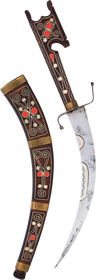
16 1/4 d.e. blade etched both sides with panel of Arabic calligraphy at the forte and thluth script to the remainder. One piece contoured bone grip with black horn top.
|
Southeast Africa. 19 1/4 length. The head incorporating the root cluster and finely carved in the shape of a rhino horn base. See our Sept. 2007 catalog, item 742
|
Mid 19th century. 8" height and employing the same artistry as the Ogboni figures, which are cast in pairs. This example, female with exaggerated genitalia in a position of supplication with a chain around her waist and chin from wrist to wrist, along the
|
14 3/4 length and carved from a single piece of wood in the shape of a ship carpenters axe. That form predates the machine made axes of the mid century. The integral haft of elegant early form as well.
|
23 length plus the excess string. Worn to protect the warrior in battle and deliver him if killed. The Somali followed the Mad Mahti and this amulet dates to the Sudanese War of 1885.
|
10 length. Carved from a single piece of wood with stylized cruciform top decorated with geometric panels and a representation of a Hadendoa cult knife. Two prongs used to tease the hair, then the pick was worn in the hair to identify the Warrior.
|
Iron head with leaf shaped point of offset recessed section. Long rectangular section support with series of chisel raised barbs to each corner its entire length. Split cane wrapped socket and slender tapering haft. 48 1/4 length. Head excellent with mot
|
From the 1885 War. Just under 6 length. Tapered hard cane shaft with spiral iron band socket and additional band below. Large barbed head above chisel raised barbed bolster. Shows good uniform aging with brown patina over frosty light pitting to the meta
|
C.1885 Mahdist War. Large proportions. 74 length with large leaf shaped iron head on chisel raised barb covered support. Thick dark wood or cane haft with hide over cord wrap socket. Head shows original hammer finish and good chocolate patina. Haft and s
|
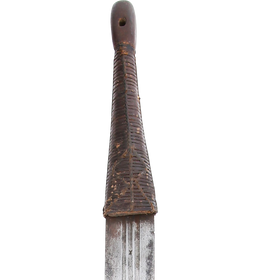
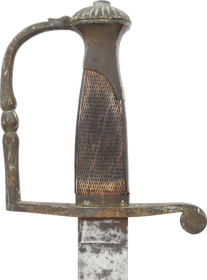
Contoured hilt encased in leather with leather lace grip covering and iron base mount.
|
35 1/2 length. Tapered wood haft with dark honey patina shows few old short splinters to the butt. Fine iron head with sharply barbed broad leaf form point and long faceted flared end socket. Fine segment of brass trade wire wrap below the point.
|
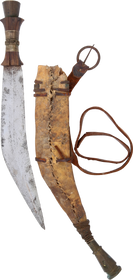
Form show by Fischer as #226. Likely fought against the Mahdists. 12 1/2 d.e. blade with broad flat medial and scalloped edge raised transverse band at the forte. Excellent for the period with evidence of lamination and few minor rust spots. Banded base
|
6 1/4 blade of flat section decorated with incised lines and raised medial. Wood hilt in two stages with tapered pommel-Stanley Pool form, but homogenous and not weighted. Fine deep rich patina to both elements.
|
12 d.e. blade. The medial and edges decorated with transverse chisel marks. Small forging flaw near the point. One piece wood grip with iron and copper bands, the top with the tang projection rolled over and capturing a ring (perhaps a link of captured S
|