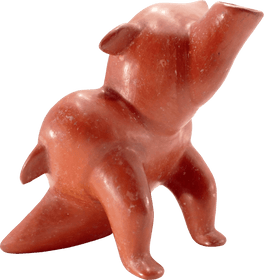
This example, of characteristic dark orange terra cotta, retains considerable black polished finish surfaces as found on Colima pottery and seen on vessels and canine figures. 2.20 length.
|
6 1/4 diameter with finely molded handles pierced for hanging. Shallow form on squat foot. Finely decorated in concentric brown slip on buff ground. Hairline cracks indicating its reassembly from about six fragments as is often the case, even with museu
|
6 1/2 height. Turnip form body, red below the waist, the upper section with four concentric circle patterns and double bands to the neck. The thick handle with brown bands as well. Excellent throughout with bright decoration beneath light surface encrust
|
La Tene culture C.400-300 BC. The Le Tene culture flourished in the area which is now southeast Germany/Austria/northeast Switzerland.
|
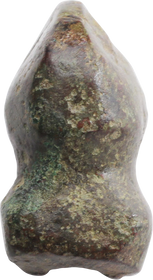
C. 400-100 BC. Bronze, 1 3/8” height.
|
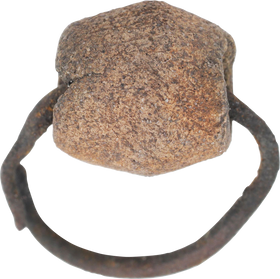
C.400-100 BC. 1 1/8” length.
|
1 1/4” length Deep relief decoration in geometric panels.
|
1” length with elongated face decorated in geometric motifs, partially obscured by surface encrustation.
|
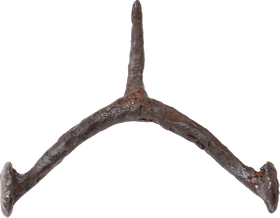
Characteristic large plain bow form. 2” length.
|
|
|
|
|
|
|
Straight out of Christ’s world! Roman Buff ware cup. First century, Roman. Wheel turned coarse wear, made for use by the working class. 4 1/2” dia., 2 1/2” height on small foot.
|
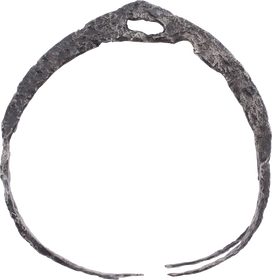
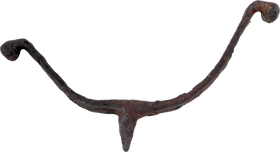
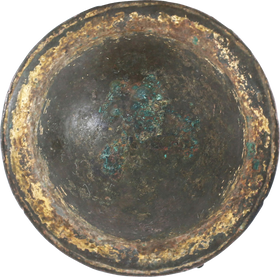
400-100 BC. 1 1/8” diameter. Bronze, surface encrusted overall. Used in pairs to secure horse harness straps.
|
First century A.D., the time of christ! Squat turnip shaped body with thickened edge flared lip. The bottom indented to form a base. A tomb miniature, just 3/4” diameter.
|
South central Mexico. The Toltecs preceded the Aztecs. 1” height, buff terra cotta, with features which accord with the Chihuahua.
|
4 7/8” height. Slightly squat spherical body with slightly angled elongated lip on swelled spout. Small suspension ring with India inked find information.
|
1st century B.C., the Ptolemaic period of Cleopatra. Open face mold made, red terra cotta, polished before firing. 1 1/6” height with full relief beetle in raised edge oval, with integral suspension ring above. Reverse with stylus finish.
|
Small fragment, 1/2” x 2” removed from a mummy.
|
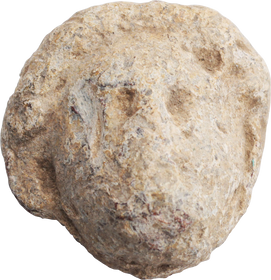
Red terra cotta, 3rd-1st century B.C. 2 1/8” height depicting a cherub face with ears pierced for ornaments. Reverse with distinct impression of the potter’s finger. Charming.
|
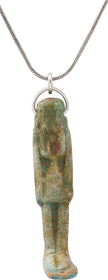
XXVI dynasty, 685-525 B.C. O.60” diameter, finely worked as the disk on integral rectangular base with the top pierced for suspension as a pendant. Excellent with much original glossy polish.
|
Red terra cotta, C.1200 B.C. 1.20” height impressed with a figure of Isis with the solar disk seated and holding a staff, producing a positive figure (amulet) 0.8” in height.
|
Pick form for armor piercing with angled double ringed socket. 6 1/4” length. Oval section blade, slightly tapered with chisel point. Stable green encrustation. Elegant..
|
Second millennium B.C. 5.25”-5.35” width varying somewhat from pinch pot construction (not wheel turned).
|
6th century B.C. Probably Samian. Red/brown terra cotta, bun form with low broad foot surrounding a central disk. Flared lip angled spout anchoring the rounded band handle.
|
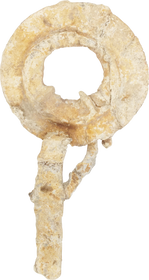
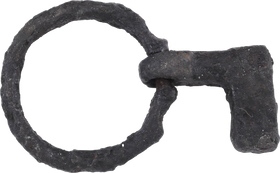
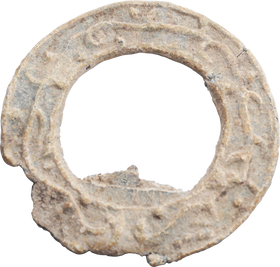
Roman Period, C.1st century BC. 1 1/8” open circular loop with a tassel or wheat sheaf at the front. Green corrosion overall.
|
18th-19th dynasty, 1549-1186 B.C. White steatite, 12 mm (1/2”) length.
|
Old Kingdom, C.2600 B.C. 0.40” length, brown steatite, carved with the beetle in full round and pierced for suspension or binding. Lightly textured from burial.
|
22nd dynasty C.900 B.C. Green fiance, 0.45” length. Well modeled beetle, bottom with oval surrounding three heiroglyphs. Lightly texture and surface encrustation from burial.
|