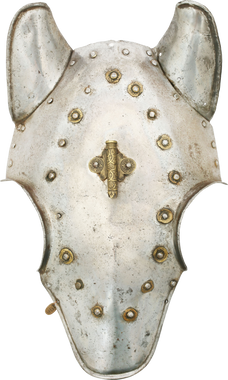
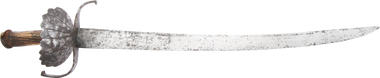
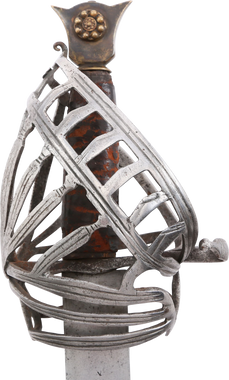
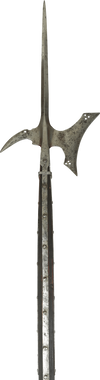
This fine armor was intended to be equally suitable for war or the tournament. For the tournament, it is designed for foot combat in which two adversaries fought armed with poleax or broadsword.
|
Among Cossacks, the hetman was the military commander. The title was used from the end of the 16th to the mid 18th centuries by the Ukrainian Cossacks.
|
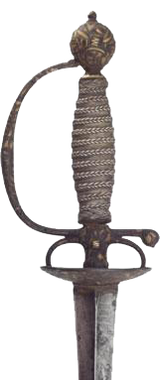
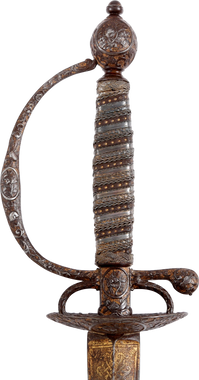
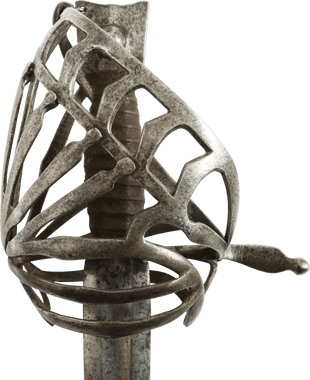
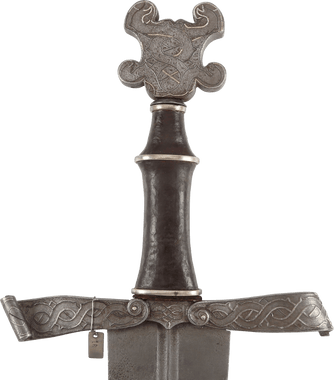
This sword is distinguished by its particularly finely chiseled and pierced iron hilt.
|
Provenance: The Boston Museum of Fine Art
Exhibited: The John Woodman Higgins Armory, Worcester Massachusetts, 1974-92
|
This sword is from a well known group studied by A. V. B. Norman. Evidently all were made in Munich and among others, served the the Munich Town Guard.
|
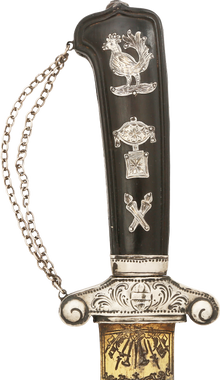
This dagger was used to parry with a rapier in the right hand.
|
This example is from the same group as #CG.145 above and displays the same characteristics of form and construction.
|
This example, of fine flamboyant form, is from a distinctly identifiable group, showing superior quality. The deep domed skull has a high broad "white" crest with roped edge.
|
The balance of the field is blackened, the transversely stippled brim polished in the "white" as well. The curved brim upturned in fine sweeping terminals. Black and white armor was produced in Germany and used both domestically and exported.
|
Rolled edge neck guard pierced for hanging and hinged cheek pieces pierced with a cluster of holes for hearing. The surface finely hammer finished and blued.
|
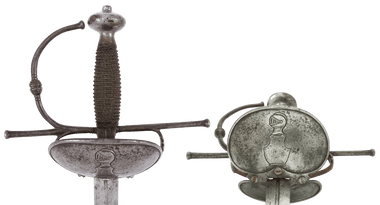
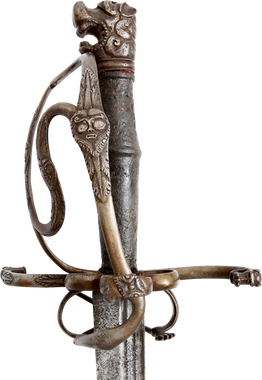
Its high rounded upper hilt bar dates this rapier to the first quarter of the 17th century.
|
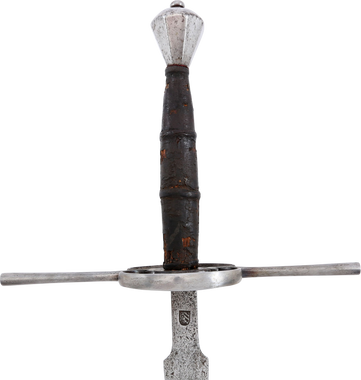
This is a cutting sword designed to be most effective against leather or partial plate armor.
|
The heavy one piece iron skull is large enough to accommodate the internal padding needed for the tilt. The roped comb provides a cushion against a blow or cut.
|
This is an example of a purely English rapier of the English Civil Wars period and the years which led to them.
|
|
37 double edged blade with broad central fuller at the forte etched each side with Prudentia et Constantia, and crowned Georgian royal cipher with the GR obliterated both sides.
|
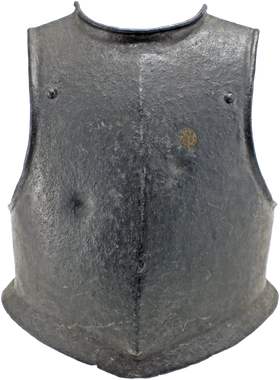
This fine breastplate represents a group produced in Western Europe and Italy.
|
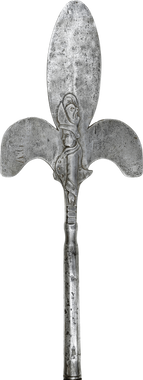
Original blackened haft. With no comparables known, this example has puzzled experts for decades. The suggestion that it was used to lead the procession of aristocrats to the gallows is very plausible.
|
With an iron basket hilt and bronze pommel with high relief contorted face motif. The typology of the Schiavona is best set forth by Oakeshott who identifies this form as Type 2.
Blade length: 36 7/8”
|
The blade is German and bears the Passau wolf mark inlaid in copper, as well as a makers mark at the forte, each side. Double edged blades are far less common than single edged examples. Blade length: 34 1/2
|
This charming dagger incorporates a fluted shell guard above the conventional ring guard in a deceptively pleasing arrangement.
|
This left hand fighting dagger is representative in form of its type but distinguished by its particularly fine inner guard guarda polvo which would show prominently when the dagger was worn sheathed.
|
This is a fine example of the swept-hilt rapier as it evolved into larger form suitable for fighting on horseback.
|
Made without a knuckle bow, this rapier represents a scarce but well documented variation for the period. The pierced and embossed shell guards are decorated with portrait heads of Charles I (1625-49) as was the fashion.
|
11 1/4 .55 cal. damascus twist barrel tapered through its length with banded flared muzzle. Miquelet lock with makers mark inlaid to the bridle. Incised ball trigger.
|
This elegant swords draws its inspiration from its Mediterranean counterparts.
|
94 1/2 length. Very similar to Stone fig. 835 #1 but with more angled transition from the axe blade to the fore spike. Tubular sockets. The axe with a cleft to the base, perhaps for arsenal racking.
|
On the right side is a mythological lion, the left a griffin. Most original gold remains. The skull, brim, cheek pieces and neck guard are all etched in matching scrolling foliage on pellet ground.
|
This sword is evidently the earliest dated example of its form. The fine hilt is comprised of a single side ring which joins the lower guard and is connected to the knuckle bow by a curved bar.
|
This fine breast-plate is a product of the Nuremberg armor industry. It was made for a light half armor without tassets. The inside is struck with the mark of the Nuremberg rolling mills which produced the steel plate from which is was made.
|