Produced under Ottoman rule, the elegant proportions of this pistol provide good balance for accurate firing. The tiger stripe circassian stock is made without provision for ram rod, which traditionally, is carried separately, strung with the primer. (read more)
|
This helmet is representative of a type of armor which gained favor in the mid-16th century. The surfaces were embossed with motifs ranging from simple bands to lavish displays accented by intricate repeated borders. The raised portions were polished ... (read more)
|
Swords of this type, identified as ribbon hilts, represent the Scottish basket hilt in its early fully developed form. The cross guard terminates in projections from which the term beaked derives, and are vestigial quillons. (read more)
|
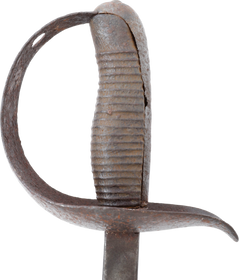
This is a good example of the type of sword which served Spain in her conquest and maintenance of colonies in the Caribbean and American southwest. It is a cavalry sword as indicated by the inscription CAVALLERIA To 1773 on the back of the blade. (read more)
|
This sword represents the rapier as it was used in Spain and her colonies in the second half of the 18th century. It is, in fact, the final form of the rapier which, by this time had been replaced by the small-sword in the rest of Europe. (read more)
|
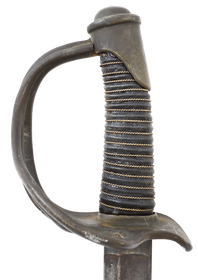
Immediately post Civil War, Carpet Bagger period which was characterized by a loss of rights by Southerners and rule by outsiders. Wood, laminated of two variant colors to accommodate the blade channel. (read more)
|
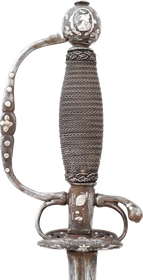
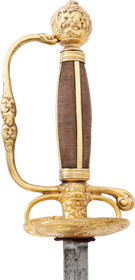
This sword is representative of a type which gained favor in the second quarter of the 18th century. It is a fine functional arms suitable for defense on the street or highway with concave faced triangular blade of colichemarde form. The plain ... (read more)
|
Carved wood, 21 1/2” height. Characterful face with thick brows, inset shell eyes and broad smile. Small pointed Van Dyke beard. The arms carved away from the sides and delineated rib cage with breast bone protruding below. (read more)
|
Of large size, decorated with three principle figures of mounted noble hunters, one with bow drawn, surrounded by a variety of wild animals, birds, shrines and a single male figure, probably a beater. The edge decorated with a band of foliage panels flank (read more)
|
This breastplate formed part of an armor from one of the many private armories in Italy which supplied family guards or militias. Those units varied from several dozen to, in some cases, thousands of troops serving a noble family directly as well as in a (read more)
|
Following the turbulent years of the Thirty Years War and the English Civil Wars, fencing for self-defense became a necessity for those who could afford training and quality weapons. It distinguished them from and advantaged them over street thugs. (read more)
|
This helmet was made in Milan, northern Italy and is identified by its decoration which is sometimes described as Pisan style. It was part of a half armor decorated overall in matching motifs which include a matrix of figures and symbols with ancient ... (read more)
|
Rare example from a near legendary group represented in several public collections. So fundamental, that it is pictured and described as the first edged weapon (pl.125 & 126) in Spanish Military Weapons in Colonial America Distinguished by the fact ... (read more)
|
40 3/4” haft length. 13 1/8” depth of the backswept crescent form head. The haft with expanded butt and showing good glossy patina. Head showing its black forged finish and dent with small delamination above the eye. Large proportions and heavy weight (read more)
|
Total length 18 1/8”. One piece, distinctive form with raised edge waisted grip for inset bone or wood grips long ago perished. Diamond section elongated leaf shaped blade with particularly sharp point. Professionally conserved with mottled patina. (read more)
|
Privately made to arm merchantmen against pirates and the British during the turbulent period leading up to the War of 1812. Iron hilt with “figure eight” guard patterned after the British 1804 cutlass. Tubular iron grip. 28’ straight narrow fullered ... (read more)
|
Pattern based on the British 1804naval cutlass with figure eight guard and cylindrical iron grip. 28 1/2" straight s.e. blade struck with a star on the right side. Stable black oxidation overall. Guard edge with a small nick and the blade with some ... (read more)
|
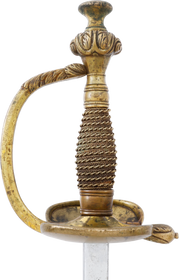
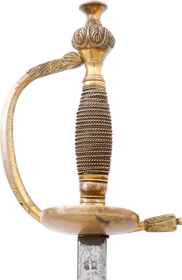
Napoleonic period, late 18th century. Brass hilt, formerly gilt, with elaborately detailed plumed helmet form pommel. Boat form guard with stippled shell splay terminal and raised segmented convex band, each segment with central dot motif. (read more)
|
From the Waterloo Museum, Broadstairs Kent England. Pattern adopted by the English as the 1796 Light Cavalry Trooper’s Sword, as well as German and Austrian Cavalries. Iron hilt with P form guard and saddled backstrap. Wood grip lacking the covering... (read more)
|
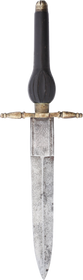
9 1/4” blade of heavy diamond section with flat ricasso both sides. Scroll terminal recurved cross guard and fluted shell shaped side guard. Fluted pommel with dish shaped top and bottom and high baluster button. (read more)
|
Large rugged example of plain form, stepped to simulate malacca and completely encased in leather with congealed surface. Concealed 27 1/2” broad fullered s.e. blade. The first half finely etched with military trophies, musical and nationalistic symbols (read more)
|
One piece dome hide skull with central hole (tehen) at the top, finely formed and preserved. Separately attached flared brim pierced for attacking the articulated shikoro (neck plates) with original filler as the entire exterior was lacquered as one ... (read more)
|
Polish or Ukrainian. Forged iron head with broad base spurs and wide triangular point pierced with a cross on base bar. That feature is likely a representation of the foot rest on the Eastern Orthodox cross which distinguishes it from the Roman version. (read more)
|
Produced by Colonial potters. Carried by soldiers for amusement at idle times and lost in Revolutionary War camps. See Neumann p.127 #9. These also were used as “checkers” on a cloth checker board. Rare large size, about 1” diameter. (read more)
|
Produced by Colonial potters. Carried by soldiers for amusement at idle times and lost in Revolutionary War camps. See Neumann p.127 #9. These also were used as “checkers” on a cloth checker board. Each about 5/8” dia. Group of six, plain and colored. (read more)
|
Forged iron with thick medial ridged leaf shaped blade and closed seam rectangular socket. Old stable rust overall with minimal pitting for the period. The Continental army was armed largely with pikes for the first two years of the war owing to the ... (read more)
|
The rapier remained popular in Spain and her colonies after it was replaced by more specialized arms in other parts of Europe. In this form, it is a horseman’s weapon used to both cut and thrust. The deep turned over edge cup derives from ... (read more)
|
Forged iron 6 1/2” height with backswept bearded form blade. Rounded top eye, elongated at the apex and somewhat asymmetrical as made. Excavated with good uniform texture and no significant losses. (read more)
|
Iron, 3 7/8 length with opened seam conical socket and cusped base triangular point with medial ridge. Sound excavated condition with stable surface oxidation. One edge with two small erosion spots and the bottom slightly degraded as well. Superior p ... (read more)
|
Zulu Wars of 1879 period. 42 1/4” length. Wood haft with good Zulu wire work bound socket and short matching segment to the butt. Long leaf shaped medial ridged head. Highly desirable short thrusting form introduced by Shaka and used like a sword for ... (read more)
|