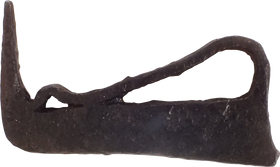
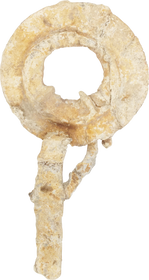
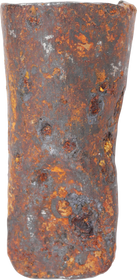
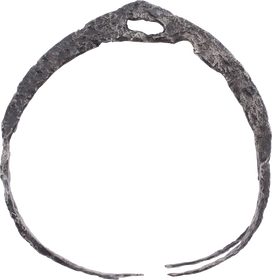
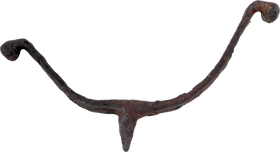
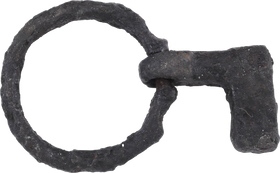
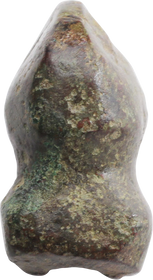
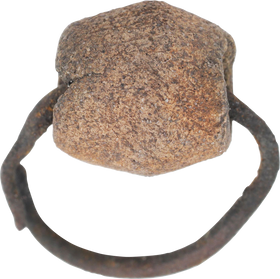
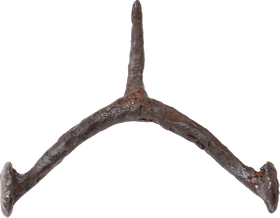
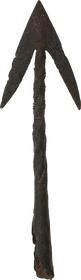
North to Alaska! Alaska Gold Rush relics. Three item group suitable for museum display.
|
A classic Deep South folk art tradition! 32 3/4” length excluding the handle. The tip reinforced with a wood plug and iron nail.
|
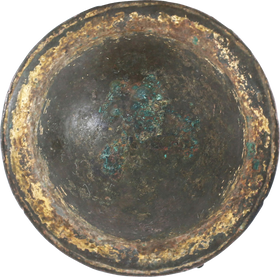
14 1/2” dia. with flat flared rim with reinforcing bead to the back. Dished center with single inscribed line decoration.
|
Original hand scribed identification accompanying 11 excavated pottery fragments from at least three vessels. Largest, a nicely crenelated edge from a jar, about 4 1/2”.
|
4 7/8” height. Slightly squat spherical body with slightly angled elongated lip on swelled spout. Small suspension ring with India inked find information.
|
1st century B.C., the Ptolemaic period of Cleopatra. Open face mold made, red terra cotta, polished before firing. 1 1/6” height with full relief beetle in raised edge oval, with integral suspension ring above. Reverse with stylus finish.
|
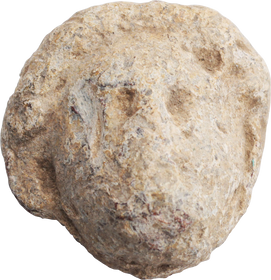
Red terra cotta, 3rd-1st century B.C. 2 1/8” height depicting a cherub face with ears pierced for ornaments. Reverse with distinct impression of the potter’s finger. Charming.
|
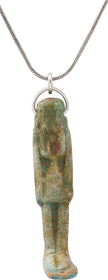
XXVI dynasty, 685-525 B.C. O.60” diameter, finely worked as the disk on integral rectangular base with the top pierced for suspension as a pendant. Excellent with much original glossy polish.
|
Red terra cotta, C.1200 B.C. 1.20” height impressed with a figure of Isis with the solar disk seated and holding a staff, producing a positive figure (amulet) 0.8” in height.
|
Rectangular with raised edge and pierced for suspension. Embossed central motif of two figures-loaves or fruit. Corner chipped, otherwise excellent.
|
1 5/8 length. Stipple decorated with the figure of a horse.
|
LARGE EXAMPLE. 2 high. Deep relief stipple decorated with two shields. Line bordered to match.
|
Carved wood, 23 7/8” height. The base finely carved as two male figures, back to back with graduated pyramidal band surrounds. The faces with representation of scarification.
|
Dating second half of the 19th century. Have a small group, evidently collected by German authorities in the 1930’s and 40’s when the Gypsies were rounded up in Germany and Eastern Europe.
|
C.320-550 A.D., a bodhisattva or perhaps Buddha. 10 3/4 height.
|
11th-15th century and representing the craft as it was reinvented after the Dark Ages. Roman form with squared base and thickened lip tapered neck. The indented bottom with a pontil ring as found on Roman examples. Light green with a few bubbles and as
|
Second half of the 19th century from Entibbe on the north shore of Lake Victoria.
|
A woman with a large pot on her head. 6 5/8 height.
|
A seated man playing a xylophone like instrument. 4 length.
|
A man in ceremonial costume with reptilian mask playing a large tension drum. 5 1/4 height.
|
Late 19th-early 20th century. One piece cane finely carved with elegant spade shaped terminal. 25 total length. The body particularly finely incised in two bands of classic Dyak geometry with additional annular bands.
|
C.300-400 A.D. Small size as interned in burials. 3 length with radial scalloped motif to the outer edge. Raised rim and smaller radial band with crenelated edge to the filler.
|
3rd-4th century A.D. Very unusual example. Hand fashioned, not mold made with mysterious designs to the top. 4 1/4 total length.
|
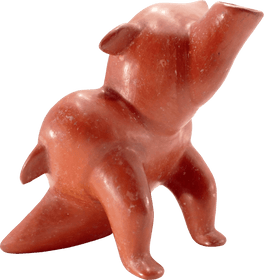
Western Mexico, C.300 BC-250AD. Brown polished terra cotta, 12 3/8 length.
|
C.1700, for home shrine worship. 4 5/8” height with lotus petal base, standing, with arms away from the body. Fine deep patina with some remnants of sacrificial material in protected places from prayer ritual (puja).
|
Dating before 1920 , the end of Armitage’s duty in Africa. 2 1/2” height, modeled as a man with flowing beard with one hand to his hip and the other holding a mask or human head.
|
14 1/2” 15 3/4”. Oil or acrylic on canvas. Unframed. An elderly white haired warrior with lined countenance and soulful closed eyes.
|
An elderly warrior in western clothes. Expressive weathered face. Evidently by the same artist as #807.
|
18th – early 19th century. 15 1/2 inch height, the lean figure approaching emaciation with elongated lower body and sandals. The hands raised from the flowing robe.
| |